

CEO Week Command Playbook: Structure Your Week Like the Top 1%
As a founder balancing product launches, investor conversations, and team issues, I used to open my calendar on Sunday evenings with the sense that the week was already decided.
Urgent messages displaced strategic work. Consecutive meetings set the pace. By Friday, I was tired and no closer to meaningful progress. This pattern is common.
High-performing CEOs do not improvise their weeks. They rely on deliberate planning rituals to regain control.
A Harvard Business School study that followed 27 CEOs across roughly 60,000 hours of activity found that they dedicate significant time — often close to 10 hours per week — to structured routines. These routines favor leverage over visible busyness.
This playbook translates that approach into a concise, AI-supported workflow.
It is designed for Sunday evenings or Monday mornings and takes 30–45 minutes, with an optional midweek reset.
Used consistently, it turns ChatGPT or a similar tool into a structured thinking aid that supports clarity under pressure.

Why Weeks Break Down
Most executive weeks fail before they begin, usually for predictable reasons:
· Unclear priorities: Everything competes for attention.
· Calendar dominance: Meetings override strategic intent.
· Information overload: Tactical noise crowds out high-impact work.
· Reactive posture: The week dictates actions instead of the other way around.
Peter Drucker’s observation still applies: what is ignored matters as much as what is done. This ritual shifts the burden of synthesis to AI so the CEO can focus on judgment and decisions.
Core Principles
Before starting, align on three operating rules:
1. Leverage over volume: Fewer priorities, greater impact.
2. Decisions over tasks: The CEO decides; teams execute.
3. Constraints create focus: Time, energy, and attention are limited.
The Six-Step Weekly Flow
Run these steps in sequence using ChatGPT. Skipping steps weakens the outcome.
Step 1: Reset and Context (5 minutes)
Clear the residue from the previous week.

Step 2: Priority Architect (10 minutes)
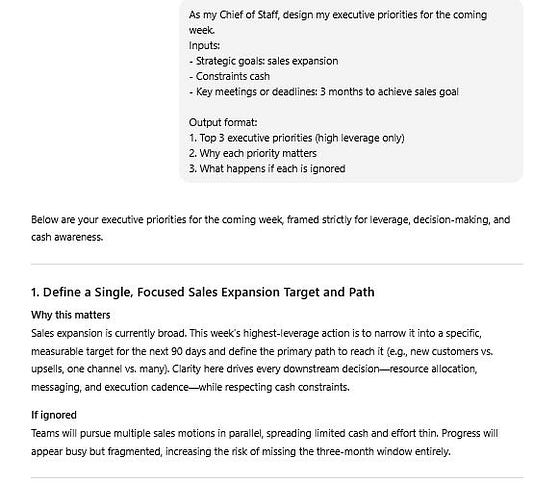
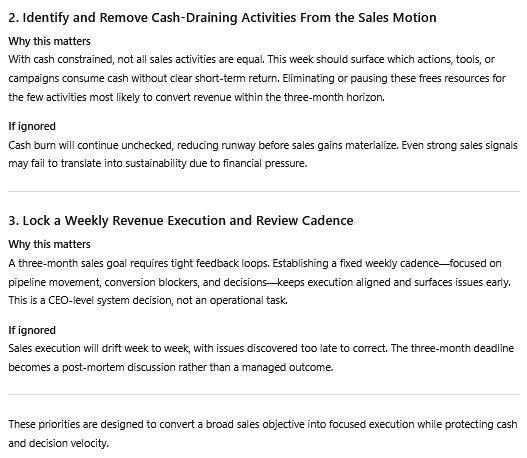
Step 3: Protect your time for what matters (5–10 minutes)
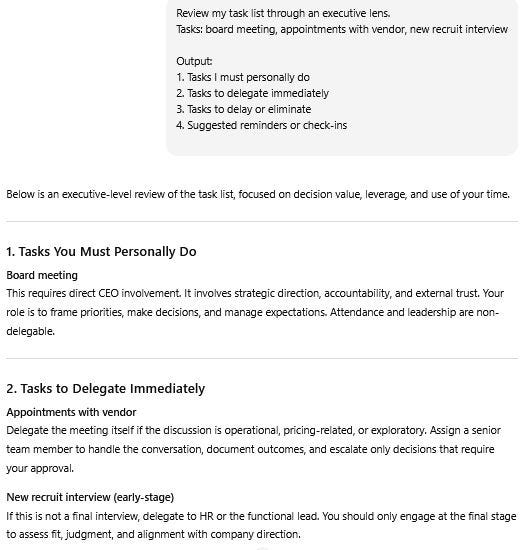
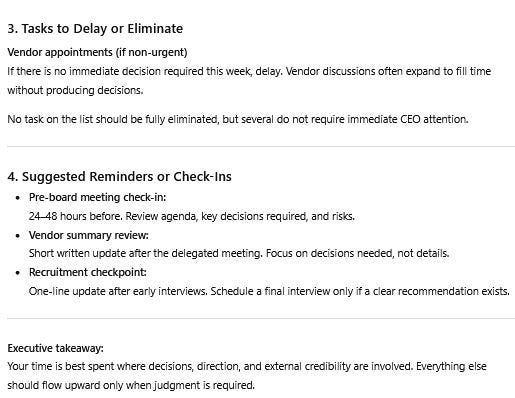
Step 4: Time Allocation Optimizer (5–10 minutes)
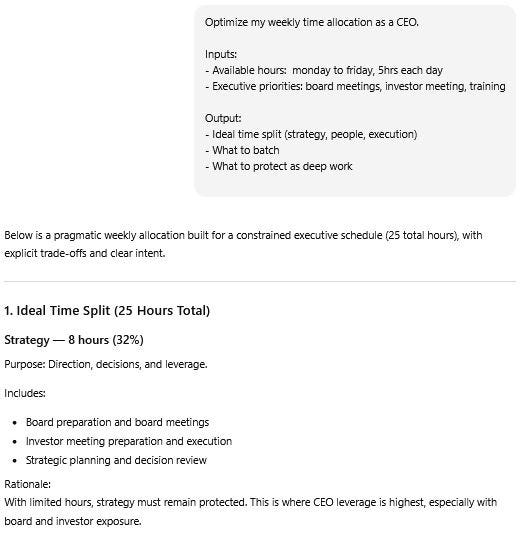
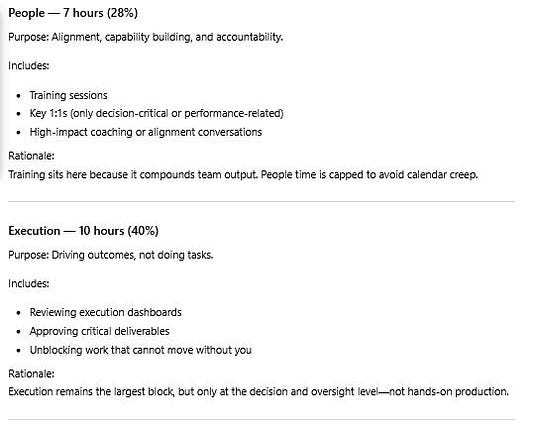
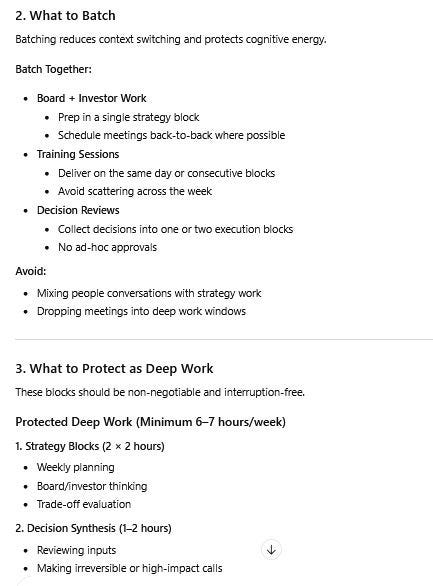
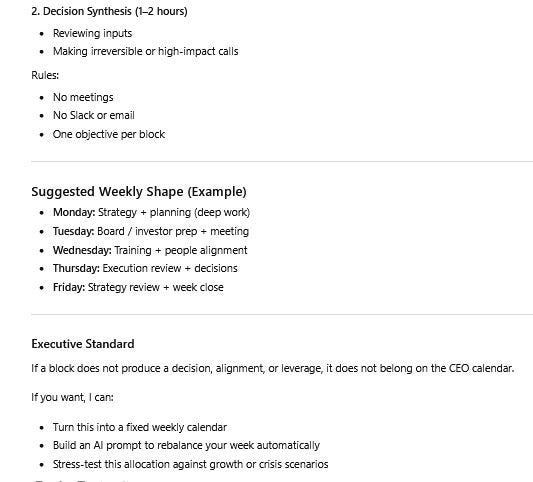
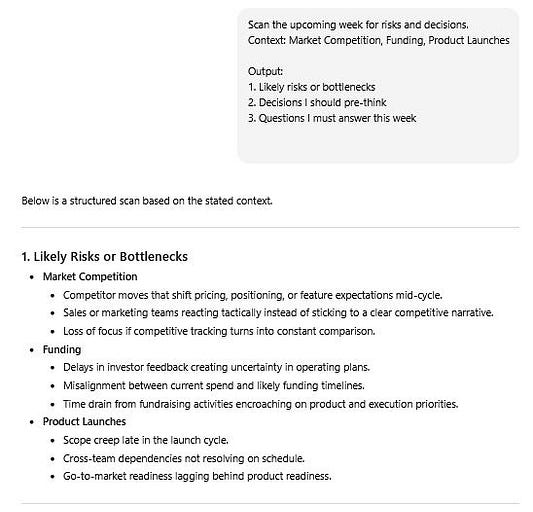
Step 5: Risk and Decision Preview (5 minutes)
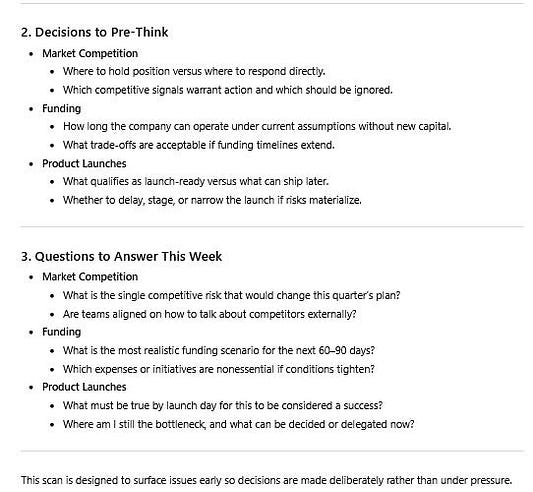
Step 6: Define Success (2 minutes)
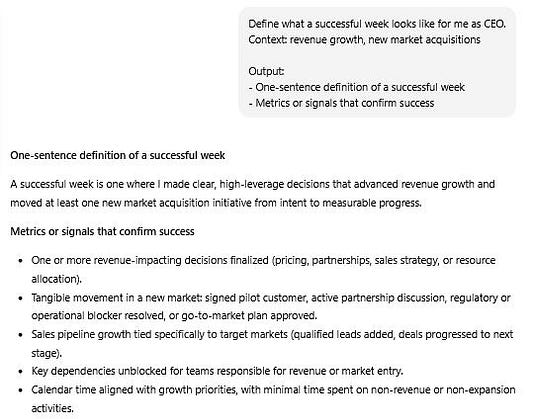
The Midweek Pulse Check (10–15 minutes)

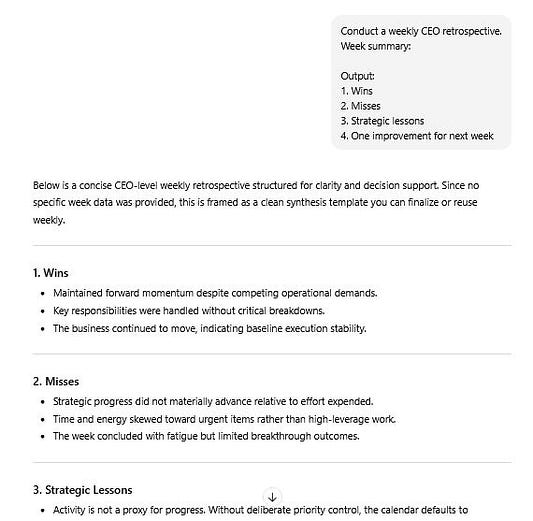
Friday Close (5 minutes)
Capture wins, misses, and lessons. These notes become inputs for the next week’s reset.
Problems This Structure Reduces
· Overcommitment: Forces deliberate elimination.
· Activity bias: Shifts focus from tasks to decisions.
· Meeting sprawl: Rebalances time allocation.
· Unresolved carryover: Builds in reflection.
The Result
A well-run week includes protected thinking time, clear delegation, and steady progress that compounds.
Research shows that CEOs who follow consistent planning rituals report stronger focus and lower stress. Practiced weekly, this approach sharpens decisions and improves output.
This playbook is part of a broader AI Chief of Staff Prompts system designed to support structured executive planning.
References
- Harvard Business School: “How CEOs Manage Time” — 60,000-hour CEO study on routines.hbs
- The CEO Project: Morning/evening rituals; HBR on 10 hours/week optimization.theceoproject
- ActionCoach: CEO Schedule framework for high-performers.fox.actioncoach
- Peter Drucker insights on management and focus.creativesafetysupply


